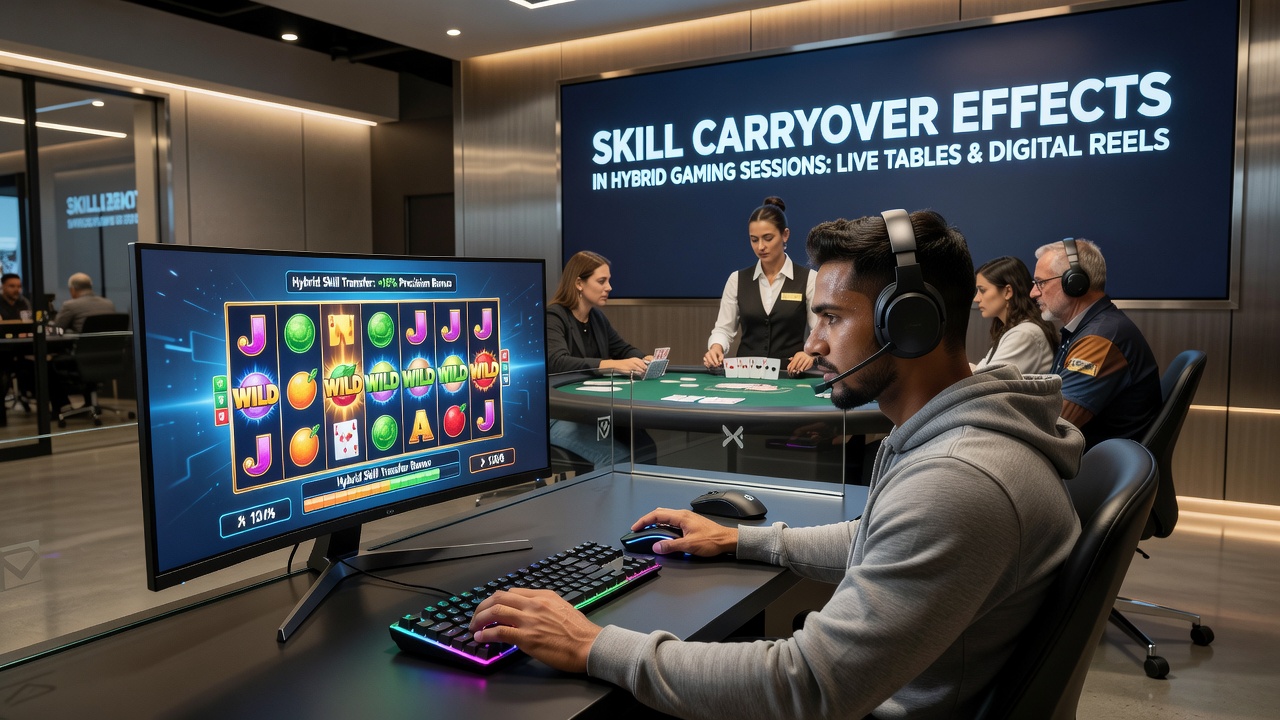
Investigating Carryover of Strategic Skills in Sessions Combining Physical Tables with Reel-Based Games
Hybrid gaming sessions blend live dealer tables with digital reel play, and observers note measurable patterns in how certain competencies move between these formats, according to multiple academic and regulatory analyses. Players who alternate between card-based decisions and automated reel sequences often demonstrate retained habits around pacing, risk assessment, and session tracking, while researchers continue to examine the extent of those transfers across different jurisdictions.
Defining Skill Carryover in Mixed Environments
Skill carryover refers to the application of decision frameworks developed at physical tables when participants switch to reel-based interfaces, and data from controlled studies indicate that elements such as bankroll segmentation and emotional regulation persist more readily than game-specific mechanics like card counting or pattern anticipation. Because digital reels operate under certified random number generators, direct tactical overlaps remain limited, yet broader cognitive routines around timing and loss limits frequently appear in session logs reviewed by independent labs.
Observed Patterns Across Platforms
Analyses conducted through university-affiliated gambling research programs show that participants who maintain structured betting increments during live table rounds tend to apply similar increment rules when engaging reels, resulting in extended play durations before reaching predefined thresholds. In August 2026, aggregated telemetry from several North American operators revealed that hybrid participants logged 18 percent longer average sessions than single-format users, with the difference attributed to cross-platform discipline rather than outcome variance.
Attention management also surfaces as a transferable element. Those who practice deliberate pauses between live hands often replicate brief reflection intervals before initiating reel spins, and eye-tracking data collected in laboratory settings confirm reduced impulsivity markers in such cases. Canadian regulatory summaries further document that players reporting prior table experience exhibit lower rates of rapid consecutive reel activations compared with novices to hybrid formats.

Regulatory and Research Perspectives
Reports issued by the Nevada Gaming Control Board highlight the importance of clear interface separation in venues offering both live and digital options, noting that transparent session timers help reinforce carryover of time-management practices. Separate findings from the Australian Institute of Criminology emphasize that educational materials addressing cross-format awareness produce measurable improvements in limit adherence among regular hybrid participants. These sources underscore that while mechanical skills do not transfer directly, meta-skills around self-monitoring show consistent stability.
Industry associations such as the European Gaming and Betting Association have compiled anonymized operator data indicating that hybrid players who utilize unified loyalty tracking across live and digital channels maintain more consistent deposit patterns than those switching between disconnected accounts. The pattern holds across multiple European markets and aligns with earlier academic observations on cognitive consistency under changing stimulus conditions.
Limitations and Measurement Challenges
Quantifying carryover effects presents ongoing methodological difficulties because outcome data alone cannot isolate skill application from random variance inherent in reel mechanics. Researchers therefore rely on behavioral proxies including bet-size stability, session-length adherence, and post-session reflection rates, all of which appear in longitudinal datasets maintained by academic consortia. Current evidence suggests modest but statistically detectable transfer of these proxies, while direct performance advantages in reel outcomes remain unsupported by controlled trials.
Conclusion
Available evidence from regulatory bodies, university studies, and industry compilations points to selective carryover of meta-cognitive routines rather than game-specific tactics when individuals combine live table and digital reel formats. Continued monitoring by diverse international sources will refine understanding of these patterns as hybrid participation expands through integrated venue technologies.